The Sprit Of Christ Gathers The Elect To The Elect

THE 12 TRIBES OF ISRAEL
1. YAHAWADAH = יהודה = JUDAH = NEGROES/AFRICAN AMERICANS/AFRICANS
2. BANYAMAN = בנימן = BENJAMIN =WEST INDIES/ JAMAICA TO BELIZE
3. LAWAYA = לוי = LEVI =HAITIANS
4. SHAMAIWAN = שמעון = SIMEON =DOMINICAN REPUBLIC
5. ZABAWALAN = זבולן = ZEBULON =GUATEMALA TO PANAMA
6. AHPARYAM = אפרים = EPHRAIM =PUERTO RICANS
7. MANASHAH = מנשה = MANASSEH =CUBANS
8. GAD = גד = GAD = NORTH AMERICAN INDIANS ,East African Tigrayan People
9. RAAHWABAN = ראובן = REUBEN =SEMINOLE INDIANS
10. NAPATHALAYA = נפתלי = NAPTHALI= ARGENTINA AND CHILE
11. AHSHAR = אשר = ASHER = COLOMBIATO URUGUAY
12. YASHASHAKAR = יששכר = ISSACHAR= MEXICANS

http://www.gatheringofchrist.org/?option=com_content&view=article&id=32&Itemid=68

Saturday, December 28, 2019

The Struggle Of The Israelites Part 1
 Let me start from The East Africa region . 


Early history Note: In Eritrea's History there is  a very important rich history never been told.  In Eritrea there are lost tribes of Israel /Northern Kingdom/ who migrated to Eritrea in the year of 721 B.C. When the northern kingdom fell Tigrinia, and Tigre Tribes [ Tribe of Gad the worrier and tribe of Ephrem] travelled to east Africa. The name of Eritrea use to be Agazian means the Hebrews who spoke Geez language.

After the fall of the Israelites  the southern kingdom / Lambas ,Igbos and Bantu's which are tribe of Judah /Benjamin, and Livi /who migrated after the 2nd temple destruction in 70 AD also went to west Africa and some of them to Eritrea Igbo tribe of Judah from Nigeria.   They lived till this day In Eritrea and Tigray region for almost 3,000 years. The Hebrew tribes of Israel still practice their Hebrew customs until this day!   Tigrinya is the language The Israelites uses, It  is about 60% Hebrew. And those Israelites  most Of them are unaware of their roots and their ancient customs even though they still practice the Hebrew customs.  Those Hebrew tribes of Israel in Eritrea are pretty much blended as one by marrying each other/ their cousins/ . That is why you can see different shades of Brown even in one family. The Israelites been at war with Turkey, Ishmaelites, Italians and those Ethiopian tribes called Amara which are the ancient Egyptians. They stole the custom of the Hebrew tribes , Geez letters, clothing, and still fight to own Eritrea land. Amhara people been fighting with Hebrews for many years by the help of Edomites, Rusians US and other allays to just stole the culture of the Hebrews. they helped Italians to separate the Hebrews into two countrys. Tigray was forsed to join Abisiniya by Ethiopian eperrior minilk  and Italians. Eritrea remains under Italians for 30 years. there is an article below how Ethiopia created to destroy the Hebrews. 

Deuteronomy 28  64 And the Lord shall scatter thee among all people, from the one end of the earth even unto the other; and there thou shalt serve other gods, which neither thou nor thy fathers have known, even wood and stone.
65 And among these nations shalt thou find no ease, neither shall the sole of thy foot have rest: but the Lord shall give thee there a trembling heart, and failing of eyes, and sorrow of mind:
66 And thy life shall hang in doubt before thee; and thou shalt fear day and night, and shalt have none assurance of thy life:
67 In the morning thou shalt say, Would God it were even! and at even thou shalt say, Would God it were morning! for the fear of thine heart wherewith thou shalt fear, and for the sight of thine eyes which thou shalt see.
 The Future prophesy for the Hebrews In Eritrea and Tigray Tribe of Gad the worrier tribe
Genesis 49
19 Gad, a troop shall overcome him: but he shall overcome at the last.


Archaeological evidence of pre-humans has been discovered in the Buya region of Eritrea, near Adi Keyh. The discovery may be one of the oldest ever found, and is similar to the famous "Lucy" find. Evidence of human presence begins in the 8th millennium B.C., beginning with Pygmoid, Nilotic, Cushitic (the Afar) and Semitic (Tigrinya) 12 tribes of Israel . In Eritrea people from 10 tribes of Israel lived since 721 B.C/ Birth of Christ/.  And some are also from  tribe of Judah who letter moved to those areas and still live there . In the sixth century B.C., Arabs spread to the coast of present day Eritrea, in search of ivory and slaves for trade with Persia and India. Their language evolved into Ge'ez, related to today's Tigriniya ,Tigre, Tigray people, And still spoken by Christian priests in Eritrea and Ethiopia.

During the 3rd and 4th century AD, Eritrea was part of the kingdom of Axum which spread from Meroe in Sudan right across the Red Sea to Yemen. The capital of Axum was in the highlands of Tigray (now a province in Ethiopia), and the main port was at Adulis which is now called Zulu in Eritrea. This Kingdom was based upon trade across the Red Sea and was founded by Semitic people originally from Arabia. Christianity was the predominant faith of Axum introduced through contact with traders throughout the region.
By the 6th century AD the Persian Empire expanded and with it went the expansion of Islam. In 710 AD Muslims destroyed Adulis and the ancient kingdom of Axum declined until it was reduced to a small Christian Enclave. For the next few centuries, the region settled into being a remote, isolated community only re-emerging by the early 16th century as Abyssinia. The Abyssinian Kingdom covered the Ethiopian highlands ruled by kings and peopled by Christian Tigrinya and remaining fairly isolated. The community had little or no contact with the lowlands of the region which was home to predominantly Muslim communities.
This period in Eritrea's history is highly contentious. Ethiopians claimed Eritrea had been an integral part of historic Ethiopia but though there are some common practices and religious beliefs between Eritreans and Ethiopia, these ties do not extend throughout Ethiopia. In fact, large parts of Eritrea, it would seem, were linked to other empires. The Ottoman Empire and Egypt had relations with the northern and eastern part of the country, and various Sudanic Empires to the west and north-west have had their influence.
19th century expansion
Abyssinia was subject to the expansionism of the Egyptians and some European powers (French, Italian and British). In the early parts of the century, Ali Pasha invaded Sudan and gradually pushed on the Western Lowlands of present-day Eritrea. By mid-century, European interest in the area was increasing. The British had a consulate in Massawa, and the French already had a presence. Italian missionaries were established in Keren.


Emperor Tewodros II, who ruled Abyssinia from 1855-68, also had to deal with rebel forces in Tigray and Soha, who chose Ras Kassa as their ruler. Tewodros was defeated in 1868 after the British General Sir Robert Napier had landed in Zulu to release the Consul and other prisoners held by the emperor. After Tewodros defeat, Ras Kassa was crowned Emperor Yohannes IV in 1872. Yohannes forces won a significant battle against the Egyptians at Gura in 1875. From this victory, Yohannes' foremost General, Ras Alula, became governor of the province of Hamasien and prince of Eritrea.
Italian influence
The first Italian mission in Abyssinia was at Adua in 1840, under Father Giuseppe Sapeto. He was the vehicle through which the Italian government brought up pieces of land near Assab, initially on behalf of the national Rubattino Shipping Company. But as the European 'Scramble for Africa' gathered pace, the Italian government took over the land in 1882 and began to administer it directly. They also ousted the Egyptians from Massawa on the coast. However, expansion further inland soon led to clashes with Emperor Yohannes. In 1887, Ras Alula forces inflicted a heavy defeat on the Italians at Dogali, forcing them to retreat.
This was a significant victory for Yohannes, who was also facing a number of other threats on different fronts at the same time - not only the Italians, but the Dervishes and Menelik, an increasingly disloyal general. Yohannes was eventually killed after being captured in battle against the Dervishes at Galabat. Following his death, Ras Alula withdrew to Tigray. This allowed Menelik to be named Yohannes successor in 1889 with substantial Italian backing, instead of the natural heir, Ras Mengesha.


The Italians then moved rapidly, taking Keren in July 1889 and Asmara one month later. Menelik had signed the Treaty of Uccialli with the Italians the same year, detailing the areas each controlled. Just four years later, Menelik renounced the treaty over a dispute arising from further Italian expansionist attempts. After more military clashes and in the face of sizable Italian reinforcements, Menelik signed a peace treaty. Italy then began establishing colonial rule in the areas it controlled, as defined in the treaties with the Ethiopian emperor in 1900, 1902 and 1908.
Colonial rule
The Italians initially used a system of indirect rule through local chiefs at the beginning of the 20th century. The first decade or so concentrated on expropriation of land from indigenous owners. The colonial power also embarked on the construction of the railway from Massawa to Asmara in 1909. Fascist rule in the 1920s and the spirit of 'Pax Italiana' gave a significant boost to the number of Italians in Eritrea, adding further to loss of land by the local population.
In 1935, Italy succeeded in over-running Abyssinia, and decreed that Eritrea, Italian Somali-land and Abyssinia were to be known as Italian East Africa. The development of regional transport links at this time round Asmara, Assab and Addis produced a rapid but short-lived economic boom.
However, there began to be clashes between Italian and British forces in 1940. Under General Platt, the British captured Agordat in 1941, Taking Keren and Asmara later that year. As Britain did not have the capacity to take over the full running of the territory, they left some Italian officials in place. One of the most significant changes under the British was the lifting of the color bar which the Italians had operated. Eritreans could now legally be employed as civil servants. In 1944, with the changing fortunes in world war II, Britain withdrew resources from Eritrea. The postwar years and economic recession led to comparatively high levels of urban unemployment and unrest.
Ethiopian rule
When the British withdrew, the fate of Eritrea was left in the balance. It was known that the British favored partition - the north and west of Eritrea to Sudan, The rest to Ethiopia, which suited Haile Selassie. After initial presentations on the possible future of Eritrea, in 1949 the UN established a Commission of Inquiry with the task of finding out what Eritreans wanted for their own future. For a number of reasons, countries represented on the Commission could not agree on recommendations. The eventual decision to federate Eritrea with Ethiopia in 1950 reflected the strategic interests of Western Powers, particularly the United States. The US Secretary of State, John Foster Dulles, put this succinctly in 1952:
'From the point of view of justice, the opinions of the Eritrean people must receive consideration. Nevertheless the strategic interests of the United States in the Red Sea basin and considerations of security and world peace make it necessary that the country has to be linked with our ally, Ethiopia.'


At the same time Ethiopia had been strengthening its ties with the United States, even sending troops to fight with the Americans in the Korean War in 1950. Concerned that a weak Eritrea might be vulnerable to a communist takeover, which would threaten access to the Red Sea and trade through the Suez Canal, the United States and other western powers, acting through the United Nations, promoted the idea of Eritrea becoming part of Ethiopia. In December 1952, the UN finally declared Eritrea an autonomous unit federated to Ethiopia and hence turned Eritrea over to its most brutal and oppressive ruler to date: Ethiopia. It was the beginning of the ten-year period of absorption by Ethiopia.
Haile Selassie saw to it that the first three governors of the federated unit were related to him. Ethiopia began to violate and undermine the federal arrangement. Eritrean political parties were banned. The agreed Eritrean share of customs and excise duty were expropriated. Eritrean newspapers were censored. In 1956, Tigrinya and Arabic were forbidden as teaching languages, and replaced with Amharic. Student protests and boycotts ensued, but were repressed. Eritrean industries were dismantled and moved to Addis Ababa. In 1962, with the silent consent of the UN and USA, and again against the expressed will of the people of Eritrea, Ethiopia unilaterally dissolved the "Federation", formally, forcefully and illegally annexed Eritrea and declared it to its 14th province of Ethiopia.
For the next 30 years, Eritrea's plight was virtually ignored by the international community. Frustration at the lack of room for political manoeuvre finally resulted in the launch of the armed struggle. Ethiopia's Haile Selassie was supported for decades by the United States for geopolitical and Cold War reasons. For the US's unrestricted use of a military base, Selassie was given "aid" (i.e. military aid). This unfortunately was used against Eritrean secessionists and Ethiopian guerillas in brutal wars.


1961 - 1977 From guerrilla to an army The armed struggle began in September 1961 when a contingent of eleven fighting men, under the leadership of Idris Hamid Awate formed the first armed forces of the Eritrean Liberation Front (ELF). By mid 1962 some 500 men were successfully harassing Ethiopian troops around Agordat. On December 19th 1962, a group of policemen deserted to the ELF in Massawa, taking with them rifles machineguns, and ammunition
In the first decade, attacks by ELF guerrillas were answered by Ethiopian reprisals, often directed against any civilian population. Ethiopian forces burned villages, sometimes massacring hundreds of villagers. Waves of refugees began to pour into Sudan. As a result the sympathy that might once have existed among some sectors of the population for a close relationship with Ethiopia rapidly disappeared.
The period 1970 to 1974, when the ELF and the newly-emerged EPLF fought a civil war, is a bleak period in Eritrea's history. This ended when the revolution in Ethiopia made it imperative for the fronts to hold a common position to confront any proposals that might come from Addis. By this time the EPLF was establishing itself as a powerful force. During 1974/75 it further strengthened itself by successfully recruiting Eritreans with military training from the Ethiopian police force in Eritrea, and from Eritrean commando units which it had successfully defeated. A large influx of young people joined the EPLF after 56 students were garroted with electric cable in Asmara in January 1975.
By mid 1976, began the launching of the 'Peasant Army' offensive against Eritrea. The Eritrean guerrilla forces (estimated to number 20,000) managed to win considerable victories against the occupying Ethiopians. The EPLF laid siege to Nacfa in September 1976. In 1977 they took Karora, Afabet, Elaberet, Keren and Decemhare. They also surrounded Asmara, Eritrea's capital and organized the escape of 1,000 political prisoners from Asmara's jail. The ELF took Tessenei, Agordat and Mendefera. By the end of 1977 the mainland Massawa was in the hands of the EPLF, which now had captured tanks and armored vehicles. They were close to final victory in early 1978, but had not planned on the Soviet Union's crucial intervention in the form of military aid for Mengistu's regime in Ethiopia.  
1977 - 1988 Soviet intervention
The Soviet Union intervened in December 1977. The Soviet navy, by shelling EPLF positions from their battleships, prevented the EPLF from taking the port section of Massawa. A massive airlift of Soviet tanks and other arms allowed the Ethiopian army to push back the Somali forces in the Ogaden, and by May/June 1978 these troops and heavy Armour were available for redeployment in Eritrea. In two offensives the Ethiopian army retook most of the towns held by the Eritrean fronts.
For the EPLF the return to the northern base areas was 'a strategic withdrawal'. It minimized civilian and military casualties. It also allowed the EPLF to give battle at strategic points of its choosing, to evacuate towns and to remove plant and equipment to its base area.
For the ELF the story was different. In attempting to hold territory its casualties were high. The balance of military power between the fronts had now shifted strongly towards the EPLF. Recognizing its weaker position, worsened by ethnic disputes, the ELF began in 1979 to respond to the Soviet proposals. In return for its agreement to autonomy within Ethiopia the ELF was offered the reins of government in Eritrea, while the EPLF stood for a secular and socialist state of Eritrea, rejecting ethnic differences.
A bitter civil war between the ELF and the EPLF resulted, that the EPLF finally won in 1981. ELF fighters either changed sides or fled to Sudan, and the EPLF became the single front with a military presence in Eritrea. The EPLF successfully resisted offensives in 1982 and 1983, while the Dergue organized genocidal responses to eliminate the broad civil support to EPLF liberation movement. But the EPLF lines held and the morale and confidence of the EPLF were given massive boost while the Ethiopian army was demoralized. Its net effect was to strengthen the range of military equipment at the EPLF's disposal.


Ethiopian forces tried to weaken the morale of the population of Eritrea by hangingcaptured EPLF fighters and civil collaborators in the center of the Eritrean villages.

Through most of the war, Ethiopia occupied the southern part of Eritrea. The EPLF had to settle in the inhospitable northern hills towards the Sudanese border. These hills became a safe haven for the families of soldiers and the orphans and disabled. Consequently, much of the regions around Afabet and Nacfa in Sahel province became home to makeshift homes, schools, orphanages, hospitals, factories, printers, bakeries etc. in an attempt to live life as normally as possible under extraordinary conditions. Most structures were built either into the ground or in caves to avoid being bombed by Ethiopian jets. The steep narrow areas were chosen as they were the hardest for the jets to negotiate.
In 1984, while Mengistu was spending lavishly on a celebration of the tenth anniversary of his glorious revolution, one-sixth of the population of Ethiopia was in danger of dying of starvation, and ten thousand people per week were already dying. As part of the "politics of famine", Mengistu began using his power to block delivery of grain to areas he considered hostile to him, most notably Tigray and Eritrea. Innocent people starved to death while grain sat undelivered.

1988 - 1993 The victory At the end of the 1980s, the Soviet Union informed Mengistu that it would not be renewing its defense and cooperation agreement with Ethiopia. With the withdrawal of Soviet support and supplies, the Ethiopian Army's morale plummeted and the EPLF began to advance on Ethiopian positions. In 1988, the EPLF captured Afabet, headquarters of the Ethiopian Army in northeastern Eritrea, prompting the Ethiopian Army to withdraw from its garrisons in Eritrea's western lowlands. EPLF fighters then moved into position around Keren, Eritrea's second largest city.
The EPLA (military branch of the EPLF) by this time includes twelve infantry brigades (some 20,000 fighters), 200 tanks and armored vehicles, and a fleet of fast attack speedboats, all captured in battle and in guerrilla raids from the Ethiopians. EPLA's disadvantageous combat ratio ranged from 1:4 to 1:8, but the battlefield mortality ratio was at least ten Ethiopians to one Eritrean, due to better trained and more committed fighters.
In 1990 the EPLF had captured the strategically important port of Massawa, and they entered Asmara, now the capital of Eritrea, in 1991. The Ethiopian army under Haile Mariam Mengistu (an army officer who deposed Haile Selassie in 1974) intensified the war against Eritrea, but it was easily defeated in 1991 after Mengistu fell from power.
It was at 10:00 a.m. on May 24, 1991 that Asmara residents realized EPLF fighters had entered their city. In a spontaneous outburst of happiness and relief, Asmarinos flung open their doors and rushed into the streets to dance in jubilation, some still in their pajamas. The dancing lasted for weeks.


At a conference held in London in 1991 the Ethiopian People's Revolutionary Democratic Front (EPRDF), who were now in control of Ethiopia having ousted Mengistu and were sympathetic to Eritrean nationalist aspirations, accepted the EPLF as the provisional government of Eritrea. So began the long process towards independence and international legitimation of Eritrea as a country in its own right.
In April 1993 a referendum was held in which 1,102,410 Eritreans voted; 99.8% endorsed national independence and on May 28 Eritrea became the 182nd member of the UN. Later that year, Eritreans elected their first president, Isaias Afewerki, formerly secretary-general of the EPLF.
Thus it is now eligible to receive international aid to help reconstruct and develop its shattered economy. Since establishing a provisional government in 1991, Eritrea has been a stable and peaceful political entity, with all political groups represented in the transitional government.
The war has had a devastating effect on Eritrea. Around 60,000 people lost their lives, there are an estimated 50,000 children with no parents and 60,000 people who have been left handicapped. However, there is now great optimism with people pulling together to rebuild the country. The National Service, announced on July 14th 1994, required all women and men over eighteen to undergo six months of military training and a year of work on national reconstruction. This helped to compensate for the country's lack of capital and to reduce dependence on foreign aid, while welding together the diverse society.


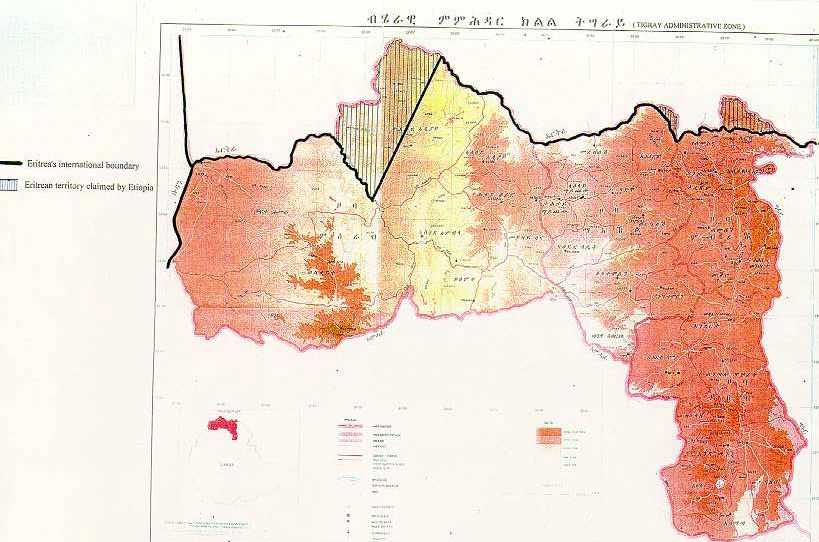
1997 The border conflict Following Eritrea's independence in 1993, a boundary commission had been established to cover the Yirga Triangle (Badme) and other disputed areas. In 1997, the Ethiopian authorities issued a map of the Tigrayan Administrative Region which confirmed Tigrayan expansionism. The map proved to be the end of the good relations between Eritrea and Ethiopia, and resulted in an armed conflict in August 1997 and an all-out war in May 2000, when Ethiopia occupied large parts of Eritrea. An estimated 1.1 million Eritreans have been displaced by Ethiopian aggression and an estimated 100.000 Ethiopian and 20.000 Eritrean soldiers were killed in this two year war.
On June 19th 2000 both parties agreed on a ceasefire and on December 12th 2000 a peace agreement was signed in Algiers. A 4200-strong multinational UN peacekeeping force (UNMEE) was deployed for the de-mining and demarcation of the border.
On April 13th 2002 the Permanent Court of Arbitration in The Hague published the conclusions of the Eritrea-Ethiopia Boundary Commission. The lands bordering the Yirga Triangle, areas, including Badme in the Central zone and Eastern Sector and border town Tserona have been awarded to Eritrea. The border towns Zalambessa and Alitena (Central Sector) and Bure (Danakil Depression) were awarded to Ethiopia.
Background to the border conflict > > >


Psalm 83

King James Version (KJV)

83 Keep not thou silence, O God: hold not thy peace, and be not still, O God.
2 For, lo, thine enemies make a tumult: and they that hate thee have lifted up the head.
3 They have taken crafty counsel against thy people, and consulted against thy hidden ones.
4 They have said, Come, and let us cut them off from being a nation; that the name of Israel may be no more in remembrance.
5 For they have consulted together with one consent: they are confederate against thee:
6 The tabernacles of Edom, and the Ishmaelites; of Moab, and the Hagarenes;
7 Gebal, and Ammon, and Amalek; the Philistines with the inhabitants of Tyre;
8 Assur also is joined with them: they have holpen the children of Lot. Selah.
9 Do unto them as unto the Midianites; as to Sisera, as to Jabin, at the brook of Kison:
10 Which perished at Endor: they became as dung for the earth.
11 Make their nobles like Oreb, and like Zeeb: yea, all their princes as Zebah, and as Zalmunna:
12 Who said, Let us take to ourselves the houses of God in possession.
13 O my God, make them like a wheel; as the stubble before the wind.
14 As the fire burneth a wood, and as the flame setteth the mountains on fire;
15 So persecute them with thy tempest, and make them afraid with thy storm.
16 Fill their faces with shame; that they may seek thy name, O Lord.
17 Let them be confounded and troubled for ever; yea, let them be put to shame, and perish:
18 That men may know that thou, whose name alone is EHYAH, art the most high over all the earth.
 Horror In The Sinai: Israel Teargases Eritrean Refugees Begging For Their Lives
12 September 2012
 haaretz.com 
It is real: The story of the tragic saga of Eritrean Refugees in the hands of Israeli Defense Forces (IDF) is horrific. A report in Israel's Daily Newspaper Haaretz yesterday disclosed: Horror in the Sinai: Israel teargases Eritrean Refugees begging for their lives! Read below for details: 

Testimonies suggest that the men who had been trapped at the Israeli-Egyptian border for 8 days were tear gassed, forcefully dragged into Egyptian territory. 
By Talila Nesher | Sep.11, 2012 | 7:44 PM
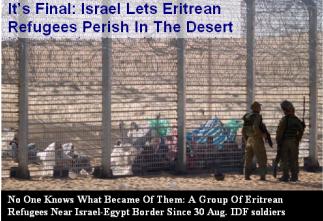
For the first time since they were allowed into Israel, the three Eritrean migrants who were held at the border with Egypt along with 18 others for over a week, served affidavits claiming that the IDF used physical force as well as tear gas against the migrants.

The two women and one 14-year-old boy were sent to Saharonim Prison in the Negev after being allowed to enter the country.

The three delivered testimonies to attorneys Amar Shatz and Yiftah Cohen from the We Are Refugees organization, which contradicted the previous statement released by the Prime Minister’s Office as well as the state’s response to the High Court, according to which the group of 18 Eritreans “returned to where they came,” suggesting that they returned to Egypt out of their own volition.

From the third affidavit, which was given separately, it was revealed that Israeli security forces which crossed the fence into the Egyptian side “used force, held them physically and pushed them onto a tarp which was dragged over to the Egyptian side.”

The three told the lawyers that “some of the men had fainted, that everyone was starving and that they tried helplessly to resist while pleading and yelling to be killed rather than being sent back to Egypt.” According to the affidavits, the IDF used tear gas against the Eritreans.

We Are Refugees has called for an investigation “regarding the state’s alleged actions and its public statements, namely to shed light fate on those who are missing.”

The IDF Spokesperson Unit has yet to issue a response.

The Prime Minister’s Office refused to respond to Haaretz’s probe over the nature of its previous statement, which hinted that the migrants returned to Egypt on their own accord.

The PMO also refused to respond to the question of whether it is in contact with Egyptian officials who promise the ensure the safety of the migrants, or whether it was promised that they would not be sent back to Eritrea before having their asylum seeker status checked beforehand. Moreover, the PMO did not respond when asked whether its personnel know the whereabouts of the 18 Eritreans that were sent back to Egypt.

According to international law, should Israel decides to not grant asylum to the migrants, it must arrive at an agreement with Egypt, which would ensure that they will allow them the opportunity to be absorbed by the state, and will not be deported back to their home country. 


Refugee slaves, explodes the emergence of the field of Shagarab: UN report at the Palais des Nations in Geneva


Emilio Drudi

The last case is a few days ago, four young Eritrean refugees in Sudan were kidnapped in the refugee camp Shagarab. Of them do not know anything. Everything leads us to believe that, like hundreds, maybe thousands of other boys, they ended up in the hands of human traffickers. Criminal groups whose interests and whose bases are now operating from the northern borders of Eritrea and Ethiopia to Sinai, on the threshold of the border with Israel.

Just Shagarab the field from which the four girls have disappeared, in fact, has become an inexhaustible source of supply for the rampant "market" of men and women. Indeed, perhaps the main source, so it can be considered an emergency in the already huge, dramatic emergency general of refugees and migrants who escaped from the Horn of Africa, are increasingly prey to organizations that exploit their despair, sequestrandoli and making slaves. Once captured, in fact, their future is doomed. To free the kidnappers demanding a huge ransom in the last month has been reached to 35-40 thousand dollars, a figure that equates to more than a lifetime of work in the countries from which those young people, especially Eritrea, but also the 'Ethiopia and Somalia, where the average income does not reach two dollars a day. For those who can not pay there is no escape. Men are sold as arms for forced labor to private companies or unscrupulous. For women is even worse: they are designed to forced marriages or, more often, the international tour of prostitution. Not to mention the risk of ending up in the black market of organs for transplantation, offered to patients around the world by clinical complacent or that you do not ask too many questions about the "donors".

The agency Habeshia Don Mussie Zerai, which deals in particular assistance to Eritrean migrants and more generally in the Horn of Africa, denounces this situation for years to Shagarab. Now, a detailed report was presented at the Palais des Nations in Geneva also by Melissa Fleming, spokeswoman of the UN High Commissioner for Refugees.

Shagarab is one of the collection centers refugees oldest and largest of the eastern Sudan. Opened in 1968 close to the Eritrean border, hosts currently in three different fields nearly 30,000 refugees: 29,445 seconds the latest UN estimates. It is in the vast majority of young men and women, with a good level of education and who see in the Sudan only a transit area: their goal is to reach Europe or the West, crossing the Mediterranean from North Africa or the Sinai desert to cross the border of Israel, regarded as a European outpost. Almost all of them are victims of political persecution or, especially the Eritrean deserters or draft dodgers. Guys, that is, who want to avoid military service imposed by the dictator Isaias Afewerki and that usually takes much more than 18 months provided: often lasts for years and years, until old age, making them conscripts to life. But this their anxiety to escape from war, persecution and hunger for freedom, civil rights and the better future they hope to find in the West, making them easy victims of traffickers.

Getting a visa to travel abroad from Sudan is very difficult and requires a very long time. Even in the most obvious cases of political persecution and risking their lives if they return. So, after years of waiting in refugee camps, they rely increasingly on "smugglers" who promise to take them to pay a ticket which is around $ 5,000, up in Libya and there in Europe or in Israel through Sinai. But these guides are actually linked to gangs of robbers: Before you get ahead of the border take them captives and give them to slave traders. In recent times, indeed, criminal organizations do not even expect to be contacted: are their emissaries to bring refugees from fleeing when they cross the border of Sudan or nearby or even inside the complex Shagarab. And who does not give in to the lure of "smugglers" often is kidnapped and taken hostage. From that moment begins an endless ordeal. A fate shared by thousands of young people now.
The report of the UN High Commissioner in Geneva noted that in recent months have increased enormously the mysterious disappearances from the field of Shagarab. "Some of these young people disappeared - complaint Melissa Fleming - were seized, others have paid to be smuggled into other countries. For those kidnapped are asked for a ransom. Or are delivered to traffickers who start them sexual exploitation or forced labor. Most at risk of abduction are Eritrean refugees and asylum seekers. According to numerous reports or interviews, the main perpetrators of kidnapping and human trafficking from Eastern Sudan to Egypt are members of local tribes or of Sinai, in collaboration with criminal gangs. " Over the past two years and limited only to the Eritrean UN figures speak of 619 young people from Shagarab disappeared into thin air. Of these, 551 well in 2012, confirming a striking escalation of the phenomenon. Not to mention the children of other nationalities and an unknown number, but certainly very high, the cases reported but not confirmed.

The situation is so severe that it threatens to explode an open conflict between the refugee camp and the local population. After the kidnapping of four girls, followed a day later by that of a young refugees from Shagarab have raided some villages of the district, accusing people of being complicit or at least accomplices of traffickers. Were born bloody clashes, with many wounded on both sides. With difficulty the police managed to regain control, but the tension is such that violence is likely to erupt again at any time. The police themselves, indeed, is challenged by the refugees, who accuse her of doing nothing or of not doing enough to keep away from the fields of traffickers, the emissaries, leaving them free field throughout the area from the Eritrean border in Shagarab but also beyond, up to the Egyptian border.
Hence the report presented in Geneva by Melissa Fleming, with the call to take responsibility for what is happening is that the Sudanese authorities to international institutions. It is, first of all, to put an end to human trafficking, chasing the criminal groups that have organized and run it: some of the leaders have already been identified and marked by time, but you can not catch them and bring them to justice. Maybe because I've never really been searched. Much to feed the suspicion of collusion at a high level and parallel connections with other trades, such as arms in favor of various political groups, or terrorists or maybe just criminals, who vie for supremacy in the region.
Precisely for this reason Don Mussie Zerai has repeatedly called for the European Union, the United Nations and, ultimately, the international community, to take charge of the problem, calling for more action to the states through which the route: Sudan and South Sudan, Egypt, Israel, Libya. And to start an international entrusting to Interpol, in collaboration with various national police forces. But also to open more doors of 'Fortress Europe' to refugees, asylum seekers and migrants.

With the proliferation of wars and persecutions in the Horn of Africa and sub-Saharan Africa the flow of refugees continues to grow. The Sudan has always been one of the first stages of this exodus. Almost nobody talks about it, but in the country and in the region promises a humanitarian emergency even more dramatic than at present. And the Sudan is closer than you might think: they been there almost all the refugees landed in Italy in recent years, after reaching luckily Libya and crossed the Strait of Sicily.


Monday, May 30, 2016

THE VITREOUS WIFE


Proverbs 31

1The words of king Lemuel, the prophecy that his mother taught him.
2What, my son? and what, the son of my womb? and what, the son of my vows?
3Give not thy strength unto women, nor thy ways to that which destroyeth kings.
4It is not for kings, O Lemuel, it is not for kings to drink wine; nor for princes strong drink:
5Lest they drink, and forget the law, and pervert the judgment of any of the afflicted.


6Give strong drink unto him that is ready to perish, and wine unto those that be of heavy hearts.

7Let him drink, and forget his poverty, and remember his misery no more.
8Open thy mouth for the dumb in the cause of all such as are appointed to destruction.

9Open thy mouth, judge righteously, and plead the cause of the poor and needy.
10Who can find a virtuous woman? for her price is far above rubies.
11The heart of her husband doth safely trust in her, so that he shall have no need of spoil.
12She will do him good and not evil all the days of her life.
13She seeketh wool, and flax, and worketh willingly with her hands.
14She is like the merchants' ships; she bringeth her food from afar.
15She riseth also while it is yet night, and giveth meat to her household, and a portion to her maidens.
16She considereth a field, and buyeth it: with the fruit of her hands she planteth a vineyard.

17She girdeth her loins with strength, and strengtheneth her arms.
18She perceiveth that her merchandise is good: her candle goeth not out by night.

19She layeth her hands to the spindle, and her hands hold the distaff.
20She stretcheth out her hand to the poor; yea, she reacheth forth her hands to the needy.

21She is not afraid of the snow for her household: for all her household are clothed with scarlet.

22She maketh herself coverings of tapestry; her clothing is silk and purple.
23Her husband is known in the gates, when he sitteth among the elders of the land.
24She maketh fine linen, and selleth it; and delivereth girdles unto the merchant.
25Strength and honour are her clothing; and she shall rejoice in time to come.
26She openeth her mouth with wisdom; and in her tongue is the law of kindness.
27She looketh well to the ways of her household, and eateth not the bread of idleness.
28Her children arise up, and call her blessed; her husband also, and he praiseth her.
29Many daughters have done virtuously, but thou excellest them all.

30Favour is deceitful, and beauty is vain: but a woman that feareth the Lord, she shall be praised.
31Give her of the fruit of her hands; and let her own works praise her in the gates.

The Vitreous Wife written in Proverbs 31 is nothing like the modern women. 
In the old times when an Israelite man took a wife through his and her parents he promise his in laws he will provide for his new bride and his family. Jacob sons were farmers and the man has to grow a food for his family while the woman gather woods to cook their food and bring drinking water from a well. She takes the grain her husband grew and she grind it by hand until it became a fine flour, She bake a testy bread and  she gather cotton to make garments for her husband and her family  in her own hands. She breastfeed her little ones until a toddlers age. She makes sure her children are warm by making quilts and she cleans and washes their cloths by hand.  


A Hebrew woman makes her own kitchen ware.Bread baskets flour baskets and beauty Baskets from a palm tree leaf.


A Hebrew woman grinds a corn.

 A Hebrew woman makes her colorful food Baskets.
  

New scarves from ethiopia pakistan and bangladesh - Counting Flowers
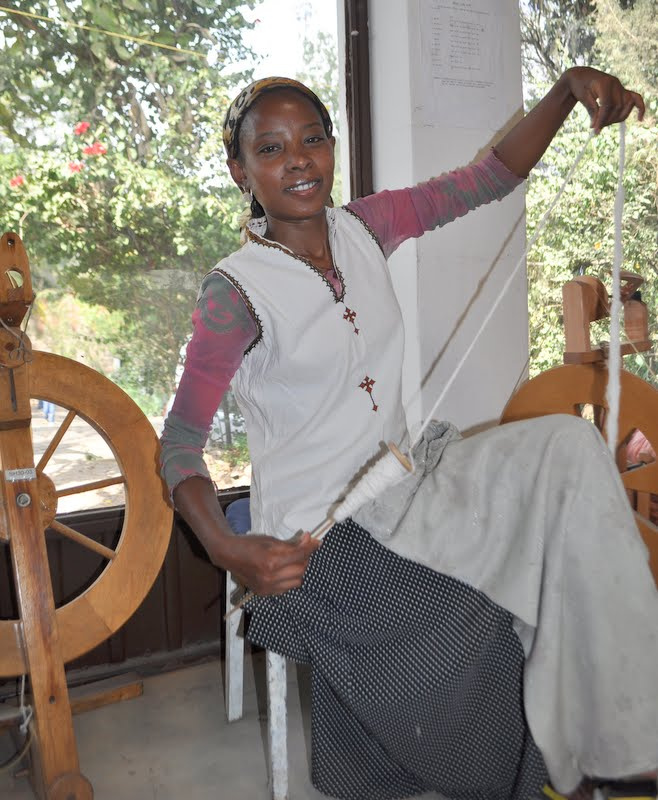
Hebrew Woman spinning cotton to make thin cotton garments


Is This woman still exist?  yes in The East African Hebrew community and other African Hebrew Countries  this woman is still exist. The Love for The Most High and the Love for her children is unconditionally. Her husband loves her provide for her and he spend his money to buy her Jewelry every time she gives him a baby. most of family have 7 to 13 children and the love amongst them is  unbelievable. Blessed is the man who married a vitreous  woman!

Thursday, May 22, 2014

HISTORY OF THE SABBATH AND THE FIRST DAY OF THE WEEK part 4

 
4th edition

PART II

CHAPTER XXI - The SABBATH DURING THE DARK AGES
Section Two: The Church in the Wilderness


Chapter XXI
THE SABBATH DURING THE DARK AGES Section Two: (The Persecuted Church in the Wilderness)
In this chapter
pages


544... The rise of Sabbath keeping sects
545... The Pasagini
547... Papal Bulls against Them
550... How their Sabbath Arguments were Met
551... The Papal Anathema and the Imperial Interdict at Verona
556... Crusade for the extinction of “heretics”
557... Inquisition Set at Work
558... Frederic II Interdicts
560... Still the Truth Spreads
561... Ethiopia holds to the Sabbath of Jehovah
563... The Jesuits at Work
564... Sabbath-Keepers in China
567... The Nasranei
567... The Sabbath in the East Indies
568... The Inquisition Active
569... The Jacobites
571... Sabbath Fasting
571... The Sabbath Dedicated to the Virgin Mary
574... Wonderful Fulfilment of God’s Prophecies


“And to the woman were given two wings of a great eagle, that she might fly into the wilderness, into her place, where she is nourished for a time, and times, and half a time, from the face of the serpent.
And the woman fled into the wilderness, where she has a place prepared of God, that they should fed her there a thousand two hundred and threescore days. (Rev. 12)
The Church in the Wilderness is the connecting link between the apostolic church and the last remnant who keep God’s commandments and have the faith of Jesus.

THE RISE OF SABBATH KEEPING SECTS We have seen that as late as the eleventh century the true Israel was still existing, keeping the Sabbath of Jehovah.
Still farther to the east there is a body of Christian Sabbath keepers mentioned from the eighth to the twelfth century. They are called Athenians (“touch not”) because they abstained from things unclean and from intoxicating drinks,-- the translator of Neander styles them Athinginians, -- as the following shows:

“This sect, which had its principal seat in the city of Armorion, in upper Phrygia, where many Jews resided sprung out of a mixture of Judaism and Christianity. They united baptism with the observance of all the rites of Judaism, circumcision excepted. We may perhaps recognize a branch of the older Judaizing sects.” 27 Cardinal Hergenrother says that they stood in intimate relation with Emperor Michael II (A.D. 821-829), and testifies that they observed the Sabbath. 28 As late as the eleventh century Cardinal Humbert still referred to the Nazarenes as a Sabbath-keeping Christian body existing at that time. But in the tenth and eleventh centuries, there was a great extension of sects from the East to the West. Neander states that the corruption of the clergy furnished a most important vantage-ground on which to attack the dominant church. The abstemious life of these Christians, the simplicity and earnestness of their preaching and teaching, had their effect. “Thus we find them emerging at once in the eleventh century, in countries the most diverse, and the most remote from each other, in Italy, France, and even in the Harz districts in Germany.” Likewise, also, “traces of Sabbath-keepers are found in the times of Gregory I, Gregory VII, and in the twelfth century in Lombardy.” 29
THE PASAGINI
During the twelfth century, the Latin records of the Inquisition often mention the name of the Pasaginians. The name is spelled several ways in Latin: Pasagii, Pasagini, Passagerii, Passagii, Passageres, Passagieri. They are first mentioned in the records of the council of Verona (A.D. 1184). In general, the church historians derive their name from the wandering, unsettled life of these people--from passage, “passage,” or, in other words, they were passengers, travelers. Persecuted and hunted down like wild game by the Romish Church, their only half-way safe retreat was in the solitude of the majestic Alps. Jas, on the other hand, derives the word from the Greek Pas-agios, “entirely holy.” Some assert that this last-mentioned term led to another appellation, Circumcisis; while others try to explain this word to mean that they were circumcised. Dr. U. Hahn, who has written an extensive history of the so-called heretics of the eleventh to the thirteenth centuries, claims:--

“The name of Pasagini was used in a twofold sense, viz., a definite Jewish-Christina sect was thus named; then it was also the general application for all the heretics, who all moved back and forth more or less, but chiefly the Cathari and Waldensians. This they did partly to spread their doctrines, and partly to escape the snares of their enemies.” 30 As to their origin, most church historians suppose them to have come from the East. Neander expresses himself as follows:

“Among the sects of Oriental origin belongs, perhaps besides those already mentioned, the Pasagii or Pasagini.” “The name of this sect reminds one of the word passagium (passage), which signifies a tour, and was very commonly employed to denote pilgrimages to the East. To the holy sepulcher, --crusades. May not this word, then, be regarded as an index, pointing to the origin of the sect as one that came from the East, intimating that it grew out of the intercourse with Palestine? May we not suppose that from very ancient times a party of Judaizing Christians had survived, of which this sect must be regarded as an offshoot? The way in which they expressed themselves concerning Christ as being the first-born of creation, would point also, more directly, at the connection of their doctrine with some older Jewish theology, than at that later purely Western origin.” 31 What Neander supposes, we have demonstrated by a regular and connected chain of evidence. The mighty crusades brought the West into closer contact with the East there were Sabbath-keepers everywhere in the East; and it would be but natural that the crusaders would come in touch with the Sabbath-keepers of the East: in fact, we have presented definite evidence of that in the case of the Bulgarians. And these so-called “Judaizing Christians” were none other than the Nazarenes mentioned by Cardinal Humbert during this very century-- the true Israel of God, who, amid all the persecutions through which they had passed, bore the reproach of Christ more than any other Christian party, wandering about everywhere as “pilgrims and strangers”, to preach the faith of Jesus and the commandments of God.
PAPAL BULLS AGAINST THEM
The papal bulss, especially those of Gregory I, and Gregory VII, and Nicolas I, are our chief source of information concerning the Pasagini. Aside from these, we have but two leading notices in Catholic histories of heretics. One is found in the writings of Bonacursus against the heretics, entitled “Against the Heretics, Who are Called Pasagii.” Its contents are as follows”--

“Not a few, but many know what are the errors of those who are called Pasagini, and how nefarious their belief and doctrine are. But because there are some who do not know them, it does not annoy me to write what I think of them, partly from precaution and for their salvation, and partly for their shame and confusion, in order that their foolishness might become more widely known, and that they might be the more condemned and despised of all. As we ought to know the good in order to do it, so likewise should we know the evil that we might shun it.
“Let those who are not yet acquainted with them, please note how perverse their belief and doctrine are. First, they teach that we should obey the law of Moses according to the letter-- the Sabbath, and circumcision, and the legal precepts still being in force. The also teach that Christ, the Son of god, is not equal with God, and that the Father, the Son and the Holy Spirit-- these three persons are not one God and on being. Furthermore, to increase their error, they condemn and reject all the church Fathers, and the whole Roman church. But because they seek to base their errors upon the witness of the New Testament and the prophets, let us slay them with their own sword by the aid of the grace of Christ, as David once slew Goliath.” 32
The following report is found in a work written by Gregorius, of Bergamo, about A,.D. 1250, against the Cathari and Pasaginians:--

“After what has been said of the Cathari, there still remains the sect of the pasagini. They teach Christ to be the first and pure creature; that the Old Testament festivals are to be observed-- circumcision, distinction of foods, and in nearly all other matters, save the sacrifices, the Old Testament is to be observed as literally as the New-- circumcision is to be kept according to the letter. They say that no good person before the advent of Christ descended into the lower regions; and that there is no one in the lower regions and in paradise until now, nor will there be until sentence has been rendered on the day of Judgement.” 33 This is all we possess concerning the doctrines taught by the Pasaginians. Their bitter enemies, biased by deep-rooted prejudice, are our only source of information. But let us closely study the brief notices we do have.
At all events, they founded their belief on the Bible, for they proved their teachings from the Old and the New Testaments. On the other hand, they condemned and rejected the writings of the church Fathers and the Roman Church, for which they certainly had excellent reasons, because the latter treated them as heretics for choosing to follow the Bible rather than the teachings of man and tradition. In this, they were centuries in advance of the Reformers. As to their belief in Jesus Christ, they were again on Biblical grounds, for Christ declares, “The Father is greater than I.” While the Word of God teaches unity of purpose in the Godhead, it nowhere states that the Father and the Son are one being; on the contrary, it declares in positive language that the Son is the express image of the Father, and consequently, he must be another being. John 17:20; Heb. 1:2. With regard to the state of the dead, they were likewise on Scriptural ground.
HOW THEIR SABBATH ARGUMENTS WERE MET
Concerning the observance of the Sabbath, they surely had a “Thus saith the Lord’ for that, while the Roman Church could meet clear, definite Scripture texts only with the most absurd spiritualising. Dr. Hahn adduces a few examples:

If the Pasaginians referred to Ex. 20:8, the Roman priests answered, “Those were no natural days, but the six working days represented the six thousand years of the world’s duration, and the Sabbath symbolized the eternal rest of the saints.
As to Jer. 17:21, it was a prophetic mystery-- whoever believed not on Christ carried a burden on the Sabbath.
Finally, their explanation of Num. 15: 32 was : The man gathering sticks on the Sabbath represents him who would be found laden with carnal works on the Judgment day and whose lot would be death. 34
As to their practise of the rite of circumcision and keeping the ceremonial law, there exist good reasons to lead us to believe that this was imply ascribed to them by their opponents. The epistle of Gregory furnishes a good illustration: because the Christians believed that the Sabbath and the ten commandments were to be observed, the Poe declared that they ought also to offer sacrifices and practise circumcision.. What one holds to be consistent, he easily imputes to his religious antagonist whether it be so or not. The Sabbath-keepers in the seventh century did not circumcise, nor did they in the ninth, or else Pope Nicolas I would not have quoted the epistle of Gregory unaltered. When we come to consider the Sabbath-keepers during the Reformation, we shall find that even Luther charged them with practising circumcision, while their own words still extant in quotations prove the contrary.
Erbkam, in his criticism of Hahn’s history, thus vindicates the correctness of our position:--

“We also believe that the reports about the Pasaginians rest partly upon misunderstanding; as for example, that circumcision is said to have been practised among them, They rightfully belong to those sects who believed the Bible.” 35 And David Benedict adds in his ‘History of the Baptist Denomination“: “The account of their practising circumcision is undoubtedly a slanderous story forged by their enemies, and probably arose in this way: because they observed the seventh day, they were called, by way of derision, Jews, as the Sabbatarians are frequently at this day; and if they were Jews, it followed of course that they either did, or ought to, circumcise their followers. This was probably the reasoning of their enemies; but that they actually practised the bloody rite is altogether improbable. 36 THE PAPAL ANATHEMA AND THE IMPERIAL INTERDICT AT VERONA
Having fully established the fact that the Pasaginians were indeed the true Israel of God, believing all the Scriptures and exercising faith in Christ, and having the entire law of god written in their hearts by the Holy Spirit according to the fulfilment of the promise, we shall now see how they were treated by the Roman Church and by the Catholic rulers.
Our first clue in this direction is given us by the famous decree against heretics, promulgated by Pope Lucian III, in the presence of, and with the support of, Frederic Barbarossa, at the council of Verona (A.D. 1183). Both the Pasaginians and the Waldensians (here referred to under the name of the “poor of Lyons” are mentioned for the first time, as follows:--

“To abolish the malignity of divers heresies which are lately sprung up in most ports of the world, it is but fitting that the power committed to the church should be awakened, that by the concurring assistance of the imperial strength, both the insolence and malapert ness of the heretics in their false designs may be crushed and the truth of Catholic simplicity shining forth in the holy church, may demonstrate her pure and free from the execrableness of their false doctrines..” “More particularly, we declare all Catharists, Paterines, and those who call themselves ‘the poor of Lyons,’ the Passagines, Josephists, Arnaldists, to lie under a perpetual anathema.” 37 Bishop Hefele and Mr. W. Jones give the following detailed account of the contents of this decree, and the manner in which it was promulgated. We quote the substance a given by Hefele:--

“For this purpose a solemn assembly of all the eminent men, both ecclesiastical and civil, was called on the fourth of November, in the cathedral at Verona. First the interdict of the emperor was proclaimed, whereupon he himself arose and confirmed it by a symbolical action, pointing with extended arms to the four corners of the earth, and with threatening mien casting his glove to the ground.
Next the imperial law was promulgated against the heretics; here upon the Pope proclaimed the ecclesiastical decree, in which all were placed under anathema-- especially those who presumed, under a form of godliness, to preach publicly or privately without the authority of the Apostolic See, as well as those who are not afraid to hold or teach any notions concerning the sacrament of the body and blood of Jesus, baptism, the remission of sins, matrimony, etc., in any way differing from what the holy church of Rome doth preach and observe.
All entertainers and defenders of these heretics are to be liable to the same sentence. If a clergyman or a monk be convicted of these errors, he shall be immediately deprived of all the prerogatives of the church order, divested of all offices and benefices, and delivered to the secular power to be punished according to his demerits.
If a layman be found guilty, unless he makes immediate satisfaction by abjuring this heresy, he shall be left to the sentence of the secular judge. Even those suspected of this heresy shall be liable to the same sentence, if they cannot clear themselves upon their examination before the bishop.
If any one relapses into his abjured heresy, he shall without any further hearing be delivered to the secular power, and his goods shall be confiscated to the use of the church. This excommunication shall be repeated by all the bishops, and renewed on all chief festivals and on any public solemnity, and if anyone be found wanting or slow therein he shall be suspended from his Episcopal dignity and administration for three years
“Furthermore, once or twice a year every bishop shall either personally or through his commissioner visit the parish in which it is reported that heretics dwell, and there cause two or three men, or, if need be, the whole neighborhood to swear what they know about said heretics. Any one thus accused shall be summoned before the bishop or his commissioner, and punished, if he does not clear himself, or has relapsed (commencement of Episcopal inquisition).
All earls, barons, governors, etc., in pursuance of the commonition of the respective bishops, shall promise under oath, that they will in all these particulars powerfully and effectually assist the church against the heretics and their accomplices, and endeavour faithfully to execute the ecclesiastical and imperial statutes. If they refuse, they shall be deprived of their honors and charges and be involved in the sentence of excommunication, and their goods be confiscated to the good of the church. If any city refuses to yield obedience to this decree, or contrary to the Episcopal commonition they shall neglect to punish opposes, we ordain the same to be excluded from all commerce with other cities, and be deprived of the Episcopal seat. All favourers of heretics, as men stigmatized with perpetual infamy, shall be incapable of being attorneys or witnesses, or bearing any public office whatsoever.” 38
This decree speaks volumes for the past, as well as for the time being. Papal anathema and the imperial edict were pronounced against the Pasaginians; and they were not only directed toward the observers of the Sabbath, but also against other companies of believers, as enumerated above. Though differing in name and in their views with reference to the understanding of God’s Word, like the various Protestant denominations of the present time, yet they all had one mutual aim, viz, to teach the gospel and to resist the abomination of the papacy.
They all dated the fall of the Roman church from the days of Constantine and Roman Bishop Sylvester; they thought the pope to be the Antichrist, and the Roman Church to be Babylon the Great. They taught that the true church consisted only of believers, and in that sense it had existed unchangeable. They highly valued the translations of the Bible in their respective languages, so that every on might read “in his own tongue the wonderful doings of the Lord.” They studied god’s Word so diligently that many knew large portions of it by heart. Even their adversaries had to give them credit for their great knowledge of the Bible.
Thus Reiner says that he met a simple, unlearned farmer who could repeat the whole book of Job word for word, and this knowledge of the Scriptures is what gave them the patience of Job in all their terrible persecutions. He found several that knew the entire New Testament by heart. 39 With the sword of the Spirit in their hands, and the love of God in their hearts, it is no wonder that they spread everywhere, in spite of such terrible decrees.
Dr. Hahn, who, to our regret, styles them only heretics says of their propaganda and success:--

“The spread of heresy at this time is almost incredible. From Bulgaria to the Ebro, from northern France to the Tiber, everywhere we meet them. Whole countries are infested, like Hungary and southern France; they abound in many other countries. In the rest of France we find them in Armoria, Paris, Orleans, Rheims, Gascogne, etc.; in Germany, in Goslar, Cologne, Treves, Metz, Strassbourg; In Italy, at Verona, Bolgna, Florence, Milan Placentia, Viterbo, Faenza, Treviso, Bergamo, Mantua, Ferrara, etc., yea, even in the papal dominions; in the Netherlands at Arras, Cambray, etc. Edicts are necessary against them in Catalonia and Aragonia, and even in England they put forth their efforts. 40 Their wide diffusion called for different leaders in various places; this explains the many terms under which the papal and imperial edicts mention them. The following new name, however, is found in the edict of King Alfonso of Aragonia (A.D. 1192)

“Whosoever, therefore, from this day forward, shall presume to receive the said Waldenses and Inzabbati, or any other heretics of whatsoever profession, into their houses, or to be present at their pernicious sermons, or to afford them meat or any other favor, shall thereby incur the indignation of Almighty God, as well as ours, and have his goods confiscated, without the remedy of an appeal, and be punished as if he were actually guilty of high treason.” 41 The term insabbati, or, as in other places less frequent, Sabbati, Sabbatati, Insabbatati, causes considerable trouble to historians. Some derive it from the wooden shoes which they wear, called sabot or Zabot; others again say that they were called Inzabbatati because they kept no festivals and only rested on Sunday; while some think the word comes from Sabbath, and was applied to them because they observed the Seventh day Sabbath.
[“The thesis that they were called Insabbatati because of their footwear is indignantly rejected by the learned Robert Robinson. (Ecclesiastical Researches, page 304) To show how widespread this term, Insabbatati, was applied to the Waldenses, the following oath is quoted which the monks directing the Inquisition would exact from prisoners suspected of holding different religious views form those of the Church

“I, Sancho, swear, by Almighty God and by these holy gospels of God, which I hold in my hand, before you lord Garcia archbishop, and before others your assistants, that I am not, nor ever have been, an Inzabbatate Waldense, or poor person of Lyons or an heretick of any sect of heresy condemned by the church…” Also in Gui, “Manuel d’ Inquisiteur” vol. 1 p. 37 For centuries evangelical bodies, especially the Waldenses, were called Insabbati because of Sabbath-keeping.”] Thus Goldastus, a learned historian (A.D. 1576-1635), says-- “They were called Insabbatati, not because they were circumcised, but because they kept the Sabbath according to the Jewish law.” 42 CRUSADE FOR THE EXTINCTION OF HERETICS As various as the explanations of this term may be, we have established the fact that some did keep the Sabbath of Jehovah. Rome spared no efforts to urge the princes to assist in the extinction of the heretics, and to prevent their spreading. When the princes of southern France could not consent to butcher thousands of industrious and orderly people, Pope Innocent III ordered a general crusade against the heretics, and full indulgence for their sins to such as would engage in this “holy” warfare. 43
King Louis VIII of France, and the Pope, exhorted;--

“unite your sword, which you have received of god to punish the evil-doers and for the praise of the just, with ours, that we might take vengeance together on these wicked and inhuman evil-doers. In Moses and peter, the fathers of both Testaments you may see symbol ion of the civil and spiritual power.” 44 In like manner he appealed to the princes, to the clergy, and to the whole French nation. He stirred up the crusaders by these words:--

“Go on, ye brave warriors of Christ, resist the predecessors of Antichrist, fight with the servants of the old serpent. Perhaps you have hither fought for corruptible honor; fight now for eternal glory! Fight against the beasts of the desert, who, like locusts, overrun the surface of the earth,” 45 Myriads were killed, sometimes under the greatest cruelties, and the garden of France was changed into a desert. INQUISITION SET AT WORK
But the army of crusaders was followed by something even worse -- the Inquisition. About the year 1200, Pope Innocent III established the Inquisition. Bishops and priests being, in the opinion of the pope, neither fit nor sufficiently diligent for the extirpation of heretics, two new orders, those of St. Dominic and St. Francis were instituted. How many observers of the Sabbath lost their lives under the tortures of the Inquisition, only the day of judgment will reveal. Wherever the popes could do so, they forced promises from princes to aid them in the extinction of the heretics, as, for example, when Emperor Frederic II was crowned by Pope Honorius (A.D.1220). Hefele says.

“But Frederic proclaimed on the day of his coronation, these laws demanded by the pope:….
5. We condemn to perpetual infamy and put under ban the Puritans, Paterines, Speronists, Leoinsts, Arnoldists, Circumcised, and all other heretics, and ordain that their goods be confiscated.
6. All magistrates are bound under oath to drive out the heretics.: 46
The observers of the Sabbath are classified here as the Circumcised. King Louis IX published (A.D. 1229) the statute Cupientes, in which he charges himself with the duty to clear southern France from heretics, and in order to bring this about he offers rewards for their discovery. 47
In the same year the council of Toulouse was held, where a number of canons were passed concerning the extinction of heretics. We quote samples:

”Canon 3,-- The lords of the different districts shall have the villas, houses, and woods diligently searched, and the hiding places of the heretics destroyed.
“Canon 4.-- If any one allows a heretic to remain in his territory, he loses his possession forever, and his body is in the hands of the magistrates to receive due punishment.
“Canon 5-- But also such are liable to the law, whose territory has been made the frequent hiding-place of heretics, not by his knowledge, but by his negligence.
“Canon 6-- The house in which a heretic is found, shall be torn down, and the place or land be confiscated.
“Canon 14-- Lay members are not allowed to possess the books of either the Old or the New Testaments.” 48
FREDERIC II INTERDICTS
Again we hear of Frederic II, this time in Germany, of whom Hefele states:--

“His second decree against the heretics repeats word by word parts 5 and 6 of the first decree;… in his third he places the Dominicans under his special protection as inquisitors for all Germany against heretical perverseness, recommends them to the faithful, and speaks of the heretics in stronger language than one might expect from Torquemada. He acknowledges it as a holy duty to persecute the children of the serpent of falsehood, and not to let these malicious people live any longer. All condemned by the church and handed over to the civil power shall be punished (be burned); in case they should repent from fear of death, they should be kept in constant imprisonment.” 49 Although the Pope and the emperor were by this time bitter enemies, yet they were agree in persecuting the heretics, as the decree of Pope Gregory IX (A.D. 1236) proves; it begins as follows:--

“We excommunicate and anathematize all the heretics, the Puritans, Paterines, the poor of Lyons, Pasagines, what-ever name: their faces might differ, but their tails are entangled in one knot.,” 50 In the year A.D. 1243, Frederic issued another decree, which thus begins;--

“We condemn to perpetual infamy the Puritans, Paterines, Speronists, Leonists, Arnaldists, Circumcised, Pasagines, Josephines, Garatensiands, Albanensians, Francisks, Bagnorols, Comists, Waldensians, etc.” 51 Here the Pasaginians and the Circumcised are separately names, and one would be justified in concluding that they were different bodies. But as Dr. Hahn justly remarks, this confusion of names makes it difficult “to classify them and to properly define them in a way that they might be distinguished from each other.” However, the Pasaginians are once more mentioned-- in the decree of Innocent IV (A.D. 1253), where he confirms the decree of Gregory IX. 52
STILL THE TRUTH SPREADS
We have now traced the history of the observers of the Sabbath down to the second half of the thirteenth century, and have found that they trod a path marked with blood. They suffered with many other faithful witnesses, and persevered unto death. They surely must have been of some importance, and scattered over quite a range of territory, or else the popes and mighty rulers of various countries would not have mentioned them with the other.
The different edicts cover a period of nearly a century. Fire, the sword, and torture were employed to wipe these sects out of existence; spies were active in all directions to hunt them down like bloodhounds on a trail; any one sheltering them risked life and property; and even if any of these “heretics” recanted, a lifelong imprisonment awaited them,. And yet the truth survived in the West, as well as in the East, to which we shall now direct our eyes.
It was from the East that the gospel started on its victorious course around the world. At an early date Syria, Egypt, Ethiopia, and Asia Minor were covered with churches; but unfortunate contentions about the nature of Christ and the Holy Spirit took away the mind of Christ a and the life-giving power of his Spirit to such a degree that these churches degenerated into formalism. While the barbarians from the North executed the divine judgments upon the apostate West, in the early part of the seventh century Mohammed arose to punish the East. In order to distinguish his followers from Jews and Christians alike, he selected Friday as the special day of prayer. And thus the “Mohammedans and the Romanists crucified the Sabbath between two thieves, the sixth and the first days of the week;” for Mohammedanism and Romanism each suppressed the Sabbath over a wide extent of territory.
ETHIOPIA HOLDS TO THE SABBATH OF JEHOVAH
One of the first conversions recorded in the book of the Acts, is that of the Ethiopian eunuch, the treasurer of Queen Candace. Two Alexandrian missionaries are said to have founded the Abyssinian church in the fourth century. Frumentius, one of these, was soon after ordained as bishop, under the title, however, of “Abba Salama,” or “father of peace;” and since that time, ”Abuna,” or “our father,” is more customary for the head of the Abyssinian church, who must still come from Egypt and be a Copt.
But the lasting monument of that time is the Ethiopic Bible. It included the book of Enoch. The Apostolic constitutions are also held in high honor. By the sixth century, Abysinia was the principal Christian power in Africa, but it was soon after so completely cut off form intercourse with Europe by the spread of Mohammedanism that gibbon fittingly writes:--

“Encompassed on all sides by the enemies of their religion, the Ethiopians slept near a thousand years, forgetful of the world, by whom they were forgotten.” 53 When Europe came anew in contact with the Abyssinians in the sixteenth century, the seventh day was their weekly rest day; Sunday was only an assembly day -- exactly as it was in the Eastern Church, when they were cut off from further contact with it by the Mohammedans. In the meantime, Christianity in Europe trampled the Sabbath of Jehovah in the dust. What caused this great contrast? Simply the efforts of the Papacy to suppress the Sabbath of Jehovah in Europe; while Ethiopia, whatever else it may have suffered, was not cursed with the presence or influence of the Roman doctrines and practises. The Mohammedans were not able to conquer this Switzerland of Africa, which was preserved like a lone isle, but they starved out its spirituality, The more their language changed, the more the Ethiopic Bible became a dead book them.
Rumors were afloat about a certain priest-king, John in Ethiopia, from the fourteenth century onward; and European legations sought him. But A.D. 1534, as Abyssinia was sorely pressed by Islam, it sent a legation to the Portuguese (who were then the great naval power of Europe), appealing for help. The Abyssinian legate at the court of Lisbon gave the following reason for their abstaining from work on the Sabbath, as well as for their honoring Sunday;

“Because God, after he had finished the creation of the world, rested thereon; which day, as God would have it called the holy of holies, so the not celebrating thereof with great honour and devotion seems to be plainly contrary to God’s will and precept, who will suffer heaven and earth to pass away sooner than his word; and that, especially, since Christ came not to destroy the law, but to fulfil it. It is not, therefore, in imitation of the Jews, but in obedience to Christ and his holy apostles, that we observe that day.: “We do observe the Lord’s day after the manner of all other Christians in memory of Christ’s resurrection.” 54 THE JESUITS AT WORK
In consequence of this request, four hundred Portuguese soldiers were sent, but they were accompanied by a number of Jesuits, who at once tried to induce the Abyssinian church to accept Roman Catholicism. They influenced King Zadenghel to propose to submit to the Papacy (A.D.1604). One of the the first efforts of the Jesuits was to get him to issue a proclamation” prohibiting all his subjects, upon sever penalties, to observe Saturday any longer.” This attempt cost the king “his crown and his life.” 55
His successor, Segued, submitted, saying:--

“I confess that the Pope is the vicar of Christ, the successor of St. Peter, and the sovereign of the world. To him I swear true obedience, and at his feet I offer my person and kingdom.” 56 The next steps Windhorn describes: “The king becoming haughty, decreed that as the observance of the Sabbath was but a ceremony, it should be discontinued, commanded to plow and to do other work on this day, and announced a severe penalty if any disobeyed. But Jonael, the governor of Bagemdra, paid no attention to this, assembled the despisers of the royal decree, and openly rebelled. Though some tried to change the kings’ mind, yet he pretended to be fully convinced that the doctrine concerning the nature of Christ and the abrogation of the Sabbath was exactly as the Jesuits had shown.” 57 Gibbon tersely remarks:--

“The Abyssinians were enjoined to work and to play on the Sabbath.” One of the first things the Jesuits did was to abrogate the observance of the Sabbath, and in order to break the resistance offered, they introduced the Inquisition. However, the Abyssinians arose to defend their religion, and after a bloody war, the king was forced to proclaim liberty of conscience. His son, in answer to the request of his nation, expelled the Jesuits (A.D. 1632), and restored the ancient faith. The harm done to the cause of Christ by the intrigues and carnal warfare of the Jesuits in Abyssinia, is stated by Gibbon:--

“Churches resounded with a song of triumph, ‘that the sheep of Ethiopia were now delivered from the hyenas of the West;’ and the gates of that solitary realm were forever shut against the arts, the science, and the fanaticism of Europe.” 58 SABBATH-KEEPERS IN CHINA But the Abyssinians are not the only Christians of the East among whom this double celebration of the Sabbath has been preserved. It is also still in vogue among the Nestorians, who reject the use of images, Mariolatry, and the Papacy. They begin their feast-days at sunset. Being exiled from the Roman empire, they found an asylum in Persia, whence they spread the gospel with great zeal, to India, Arabia, and even to China and Tartary.
As to Sabbath-keeping in China, quite evident traces have been found. When in A.D. 1665 Chinese workmen dug the foundation for a house outside the walls of the city of Si Gnau-Fou, they found buried in the earth a large monumental stone, covered with inscriptions in strange characters. The characters proved to be those called estrangellos, which were in use among the ancient Syrians, and will be found in some Syriac manuscripts of earlier date than the eighth century.
This monument, erected in the ancient city of Changan, which was then one of the most cosmopolitan cities in the world, under the imperial Tang Dynasty, shows from this inscription the evidence that the Christian religion was widely diffused in China at the beginning of the seventh century. As to the Sabbath, the following words are significant;--

“On the seventh day we offer sacrifice, after having purified our hearts and received absolution for our sins. This religion, so perfect and so excellent, is difficult to name, but it enlightens the darkness by its brilliant precepts.” 59 In connection with this an epoch in modern Chinese history is of special interest. We abbreviate from Dr. A.H. Lewis, Sabbath History. “The Ti Ping, ie., Universal Peace, Revolution, in China was one of the most wonderful developments of the power of the Bible over heathenism.” In 1833 a young man, son of a peasant, received a tract composed of extracts from the Bible, from a tract distributor in the streets of Canton. During the war between China and England, deeming it a national disaster on account of the sins of the people, he read his Christian books and was converted. From the Bible he drew his system of theology, accepting God as his father, Christ as his elder brother, and the Decalogue and the teachings of the New Testament as his guide to virtue and righteousness. The entire Bible was printed and circulated, and the Lord’s prayer and the ten commandments were printed on cards and taught in every household. Opium, whisky, tobacco, and vices were prohibited; and as the Bible is silent as to any change of the day, the observance of the Sabbath was accepted as a part of Christianity. From one of their religious publications we quote the following concerning the fourth commandment:--

“On the seventh day, the day of worship you should praise the great God for his goodness.
Remark -- In the beginning, the great God made heaven and earth, land and sea, men and things, in six days; and having finished his work on the seventh day, he called it the day of rest (or Sabbath); therefore all the men of the world who enjoy the blessings of the great God, should, on every seventh day especially, reverence and worship the great God, and praise him for his goodness.
“The hymn says:--
“’All the happiness enjoyed in the world comes from heaven;
It is also reasonable that men give thanks and sing;
At the daily morning and evening meal there should be thanksgiving;< BR> But on the seventh day the worship should be more intense,’” 60
Rev. N. Wardner, who was a missionary in China during this revolution, states that when the Europeans inquired of these Chinese Sabbath-keepers how they came to observe the seventh instead of the first day of the week, as the other Christians, they replied that it was, first, because the Bible taught it, and, second, because their ancestors observed it as a day of worship. 61
THE NASRANEI
About seventy thousand Nestorians still live in the mountainous border region between Turkey and Persia. They call themselves Nasrani (Christians), Suriani or Syrians, Mesihaye or followers of the Messiah; while the party which united with the Catholics are named Chaldeans.
Hauck-Herzog thus attests to their Sabbath observance;--

“Very numerous are their fasts. The use of meat is forbidden during one hundred fifty tow days in the year. They shun pork. The Sabbath is to them a weekly festival, as well as Sunday. They have no auricular confession; they know nothing of a purgatory. Their priests are allowed to marry.” 62 THE SABBATH IN THE EAST INDIES
The Thomas-Christians of the East Indies are a branch of the Nestorians, and, as such, they honor the memory of Nestorious, while they ascribe their conversion directly to the apostolic labours of St. Thomas. In the fifth century the Bible was translated into their language; La Croze calls this the “queen of versions.” It is marvellous how this church, separated from the other parts of the Christian world for about a thousand years, preserved its apostolic simplicity to such an extent that, when the Catholics came in contact with them, Gouvea, one of their authors, dropped the remark that the “Protestants must have imbibed their heresy from the Thomas-Christians. “
While they had formed an independent state consisting of about thirty thousand Christian families, yet, being hard pressed by the natives, they made the same mistake as the Abyssinians, and appealed to the Portuguese for protection. This protection was granted to them, but with it came also the Jesuits, and things went from bad to worse. The Jesuits began to employ force to compel them to acknowledge the Papacy, and to abrogated their ancient practises. That they kept the Sabbath would be a natural conclusion because of their connection with the Nestorians, but Mr. Yeates affirms it by saying that Saturday “among them is a festival day, agreeable to the ancient practise of the church,”
“The ancient practise of the church,” as we have seen, was to hallow the seventh day in honor of the Creator’s rest.
THE INQUISITION ACTIVE
What “gentle” means the Jesuits employed in their attempt to convert the Thomas-Christians, Mr. Yeates attests: --

“The Inquisition was set up at Goa in the Indies, at the instance of Francis Xaverius [a famous roman saint], who signified by letters to pope John III, Nov. 10 1545, ‘that the Jewish wickedness spreads more and more in the parts of the East Indies subject to the kingdom of Portugal, and therefore he earnestly besought the said king, that to cure so great an evil he would take care to send the office of the Inquisition into those countries.’” 63 With the Jesuits, the Inquisition came to India “which soon made itself felt by its terrible and mysterious punishments.” “The Jewish wickedness” was the observance of the Sabbath, as we see from the following canons of the synod at Diamper (A.D. 1599), presided over by the Roman archbishop, Menezes: --

Canon 15 -- To assure conformity of ceremonies, the synod forbids all believers to eat meat on Saturday, or else they make themselves liable to the penalty for mortal sins.
Canon 16 -- The feast- and fast-days shall commence and cease at midnight, for the eve to eve custom was Jewish.” 64
THE JACOBITES
But in A.D. 1653, when the Dutch overthrew the Portuguese, these East Indian Christians shook off the hated yoke of the Jesuits and of the Papacy. The Jacobites [a large group of dissenting Easterners who recoiled from Rome’s doctrines] began to labour among them, and about that time (A.D. 1662) and since, they form the most formidable part of the flock presided over by the Jacobite patriarch living in Diabekir.
This experience is another positive evidence that the Papacy everywhere did its utmost to suppress the observance of the true Sabbath, which they had degraded into a fast-day, and since the time of Gregory the Great, had considered the work of Antichrist. In full harmony with this, a traveler, Purchas, who visited them in the beginning of the seventeenth century, writes of the Jacobites:--

“They keep Saturday holy, nor esteem the Saturday fast lawful, but on Easter even. They have solemn service on Saturdays, eat flesh, and feast it bravely, like the Jews.” 65 With the following tribute paid to these East Indian Christians by J. w. Massie, we leave them for the present: --

“Remote from the busy haunts of commerce, or the populous seats of manufacturing industry, they may be regarded as the Eastern Piedmontese, the Vaudois of Hindustan, the witnesses prophesying in sackcloth through revolving centuries, though indeed their bodies lay as dead in the streets of the city which they had once peopled.” 66 That Sabbath observance also continued among the Jacobites who still live in Mesopotamia would be but a natural conclusion from the fact that the Thomas-Christians are under their patriarchies and still hold to it. And of this we also have definite evidence. In his history of the Jacobites, Abducanus wrote during the eighteenth century, that they assembled ever Sabbath in their temples, with bare feet, to which the later editor, J. Nicolai, adds a footnote:--

“Ou author states that the Jacobites assembled on the Sabbath day, before the day of the Lord, in the temple, and kept that day, as do also the Abyssinians, as we have seen from the confession of their faith by the Ethiopian king Claudius. From this it appears that the Jacobites have kept the Sabbath as well as the Lord’s day, and still continue therein.”67 Ross also attest that the Maronites likewise retained the observance of the Sabbath for a long time, as well as keeping Sunday. 68
The same is affirmed of the Arminians, by Seb. Frank, who writes, in the seventeenth century, that “instead of fasting on the Sabbath with the Roman Church,” “they lived well on Sunday and Saturday, rejoining in their misfortunes.” “through the whole of Septuagesima they had no mass except on Sabbath and Sunday,” 69
SABBATH FASTING
Various instances have demonstrated that the Papacy, whenever it attained the supremacy and found the observance of the Sabbath, has enjoined Sabbath fasting. Dr. Augusti also attests that some synods in France, Spain, and Germany enjoined fasting on the Sabbath during the Middle Ages. 70 That it was enjoined as late as the eleventh century is proved by canon 7, of the council held at Rome, in November, 1078. 71 But that a gradual change took place, Dr. Augusti, continuing, informs us:--

“From the eleventh century the prohibitions (to take a full meal on the Sabbath) became rarer and milder, and they would probably have ceased altogether, had not the roman Church feared she would be accused of the Greek church for her apparent inconsistency. This change was apparently brought about by the influence of a decree enforced since 1056 in Rome, at first in the monasteries, and later also among the lay members--that the Sabbath should be dedicated Mary.” THE SABBATH DEDICATED TO THE VIRGIN MARY The cause for this change is related by F.Kloden in detail:

“By the end of the eighth century the idea of the exalted dignity of Mary had reached such a height that it was thought strange to dedicate a day of the week to the honor of the Lord (besides many other feasts), and to dedicate but a few days to his mother,” “In a church in Constantinople there stood a veiled image of the Virgin. After the vespers one Friday, the veil withdrew, seemingly without human aid, and did not hide the face until vespers on Saturday. This was repeated the following Friday. After this miracle no one doubted that the virgin indicated that Saturday should be dedicated to her; It was instituted as a rule, accompanied by the following reasons: On the Sabbath after the death of Christ all faith was centered in Mary. Saturday is, as it were, the door to Sunday, which signifies eternal life. Thus Mary received a day in her honor, as well as God, and the measure rapidly found advocates and extensive circulation. 72 The noted cardinal, P. Damian, thus vindicates this measure:--

“the Sabbath, meaning rest (for on it god indeed rested) is very appropriately dedicated to the most benign Virgin, for, forsooth, wisdom in building herself a house, through the mystery of the assumed humility, rested in her as in a most holy bed.” 73 During the first crusade, pope Urban II decreed at the council of Clermont (A.D. 1095) that the Sabbath be set aside in honor of the virgin Mary by all the clergy. Many lay members followed the example of the clergy, and already the famous council of Toulouse enjoins (canon 25), under a penalty of twelve denare, “that at vespers on Saturday, the people attend church in honor of the holy Virgin Mary,” 74
In our entire investigation of Sabbath observance in the East, we have proved that certain churches, as the Abyssinians, the Nestorians, etc. honor the Sabbath of Jehovah by ceasing from work even to this day, (1910) and that all the East still honors the Sabbath in memory of the creation, by not fasting upon it. This is true even now, as the following extract from the standard catechism of the Russian church, written by the Metropolitan Philaret, proves: --

“d. The fourth commandment.
“Question-- Why, according to the command, should the seventh, and not another, day be sanctified unto God?
“Answer -- Because God created the world in six days, but rested from all the works of creation on the seventh day.
“Question-- Is the Sabbath (Saturday) kept in the Christina church?
“Answer -- It is not kept entirely as a festival; but still in memory of the creation of the world and in continuation of its original observance, it is distinguished from the other days of the week by a relaxation of the rule for fasting.” 75
On the other hand, in contrast with the East, the Papacy, wherever its influence in the West has been sufficient, has degraded the Sabbath into a fast-day, and it still stands as such in the papal laws (Gregory VII, A.D. 1078, in corpus juris canonici, c. 31. Dist. 5, de consecratione; Benedict XIV, de synodo diocesana, Roma, 1755, p. 396 ff.); but in practise it has (since the eleventh century) dedicated the day to the honor of the Virgin Mary, because Christ “rested in her as in a most holy bed.”
How generally this contrast is admitted, the following from J.W,. Neal shows:--

“The observation of Saturday is, as every one knows a subject of bitter dispute between the Greeks and Latins, the former observing it as a festival, the later as a day of abstinence.” 76 WONDERFUL FULFILMENT OF GOD’S PROPHECIES
The prophecies of Daniel and Revelation clearly foretell that a power arising in Rome after the division of the Roman empire, shall
“think to change times and laws” of the Most High;
that it shall “cast down the truth to the ground,” and shall practise and prosper; 77
That it shall “have indignation against the holy covenant;” 78
And that it shall “have intelligence with them that forsake the holy covenant,: 79
And all this we have seen fulfilled in the attitude of the Roman bishop against God’s law, against his covenant, and against his holy Sabbath.
Under anathema, the Papacy has enforced work upon God’s rest day; it as turned the day of delight into one of fasting and mourning; it has taken the day set apart to the honor of God, and dedicated it to the honor of his creature; it has substituted another time-- the first day of the week -- from the seventh day; and it has perverted the law by trying to apply the fourth commandment to Sunday; and it has had indignation against the holy covenant by attempting to erase the day written in the heart and mind of man by God’s own spirit, and seeking to write its day in the minds of men by the most cruel of human laws; and in all this it “practised, and prospered.”
Through his prophets Daniel and John, god further foretells that the saints of the Most High shall be given into the hand of this Roman power for twelve hundred sixty years, during which it shall “make war with the saints, and . . .overcome them, and the church shall, “flee into the wilderness,” where “they shall fall by the sword, and by flame, by captivity, and by spoil, many days.” 80
The British church, and the anathematized Sabbath-keepers of the East and of the west, during the dark Middle Ages, furnish a cloud of witnesses as to the literal fulfilment of the Word of God, and the most remote mountain passes testify that they served as hiding-places for the church of God.
But the same prophecies foretelling defeat, also assure final victory, for the “people that do know their God shall be strong, and do exploits. And they that understand among the people shall instruct many.” 81 “And they overcame him by the blood of the Lamb, and by the word of their testimony; and they loved not their lives unto death,”82
The great work done by the missionaries of the British church in the far North and on the Continent, the ever-wandering teachers of the Sabbath-keeping believers in the Alps, the zealous missionaries in the East carrying the gospel to India, China, Persia, Africa,-- all were strong, did exploits, instructed many, and sacrificed their lives in the service of the Master.
And though it seemed at times that the light of God’s truth would go out, yet his true Israel survived, as the following words of a church historian testify:--

“In vain did inquisitor rage, and plot, and torture, and burn. They were neither omniscient nor omnipresent: mighty as they were, they were not omnipotent. If they cursed heresy here, it sprang up there, and when hard pressed, found shelter in many an inaccessible mountain or secluded valley.”
“councils had thundered their curses, popes had issued their bulls, and inquisitors had exhausted their ingenuity -- but it was all in vain. The church of God still lived.”83


27. Neander, fourth period, 6, 428 Return>
28. Kirchengeschichte, I, 527 Return>
29. Strong’s Cyclopedia, New York, 1874, I, 660 Return>
30. Geschichte der Ketzer, 3,5 Return>
31. Chruch History, fifth period, 8, pp. 403,404 Return>
32. D’Achery, Spicilegium I, f. 211-214. Muratory, Antiq. Med. Aevi 5, f. 152. Hanh, 3, 209 Return>
33 Collectio Rev. Occitan in the Royal Library of Paris, doc. 35, quoted in Dollinger’s History of the Sects, vol. 2, p. 375 Return>
34. Ketzergeschichte. 3,8.9. Return>
35. Reuter’s Reportorium 56, 38 Return>
36. History of the Baptist Denomination, 2, 414 Return>
37. Decree of Lucian, c.9,10 de haereticis v. 7, quoted by W. Jones in History of the Christian Chruch, new York, 1824, 2,13,14 Return>
38. Conciliengeschichte, 5, pp. 726, 727; Jones 2, 13-17. Return>
39. Contra Waldenses in Max. Bibl., 25, f, 263 Return>
40. Gessch, der Ketzer, I, 13,14 Return>
41. Jones, 2,18 Return>
42. Deutsche Biographie, article, “Goldast.” 9,327 Return>
43. Bal, II, epist. 26, 27, f. 147-149 Return>
44. Bal, II, epist. 28, f. 149,150 Return>
45. Hahn I, pp. 205,206 Return>
46. Conciliengeschichte 5, 915. Return>
47. Hefele, 5, 979 Return>
48. Id. 5, 981, 982 Return>
49. Hefele, 5, 993 Return>
50. Id., I 502 Return>
51. Id. 1, 509 Return>
52. Id., 1, 518 Return>
53. Gibbons, Deline and Fall of Roman Empire” chp.47, second par. From end. Return>
54. Geddes’s Church History of Ethiopia, pp. 87,88 Return>
55. Id., pp. 311,312; Gibbon’s “Decline and Fall,” chap. 47, last par,; Windhorn’s Einl, in die Abess. Theologie, p. 75 Return>
56. Gibbon, chap. 47, last par. Return>
57. Eileit, in die abess. Theologie, p. 58 Return>
58. Gibbon, chap. 47, last par. Return>
59. Christianity in China, by M. L’Abbe Huc., vol. I chap. 2, p. 45, seq. London, 1857. Return>
60. History of the Ti (spelled both Tae and Ti) Ping Revolutions, by Lin-Le; vol. 2 Appendix A, p. 824, London, 1866. Return>
61. “A Critical History of the Sabbath and the Sunday,” Alfred Centre, 1886, pp. 244-247. Return>
62. Realencyklopaedie, 13, 734, article, “Nestorianer,” Return>
63. Yeates, “East Indian Church Hist. Pp. 133, 134 Return>
64. La Croze, Abbildung des ind. Christenst., p. 354, Leipzig, 1739. Return>
65. Purchas, “Pi. Grimmes,” part 2, b. 8, chap. 6, p. 1269, London, 1625 Return>
66. Massie, “Continental India, vol. 2, p. 210 Return>
67. Nicolai, “Historia Jacobitarum: Opera Josephi Abucadni Lugduni, 1740, cum notis J. Nicolai, p. 144. Return>
68. Unterschiedlicher Gottesdienst, Heidelberg, 1665, p. 934 Return>
69. Chronica, 1530, Chronik, 3, 231 Return>
70. Denkwurdigkeiten, 10, 385-388 Return>
71. Hegege, 5, 125, sec. 587 Return>
72. Zur Gesch. Der Marienverehrung, pp. 23-25, Berlin 1840 Return>
73. Migne, 33, c. 4. 579 Return>
74. Hegele, 5. 983, sec. 655 Return>
75. Geshichte der Kirche Russlands, p. 386 Return>
76. A Hist. Of the Holy Eastern Church, London, 1850, General Introduction 5, 1. P. 731 Return>
77. Dan. 8:12 Return>
78. Dan. 11:30 Return>
79. Dan. 11:30 Return>
80. Dan. 11:33 Return>
81. Dan. 11:32-33 Return>
82. Rev. 12:11 Return>
83. Cramp’s Baptist History, London, 1868, pp. 106,112 Return>


To part ONE of chapter twenty-one Continue to chapter twenty-two
History of the Sabbath, Table of Contents